Vessel
An unkempt vessel welcomes readers to Vessel.
My vessel today is highly caffeinated, unshowered and wearing pyjamas (it’s 2.29pm). The first thing they should put in the job description for Editor at The Pantograph Punch is “Can work in slippers and a sleeping gown with tangled hair mess and unbrushed teeth.” I’ve neglected my vessel, I'm ashamed to say – the after-effects of a quarter-year that included the launch of my new book, a freaking amazing Verb Festival (well done to Claire Mabey and the team) and this new bi-monthly issue of The Pantograph Punch.
But regardless of whatever’s going on over here (motions at dishevelled self), I’m very excited to introduce you to Vessel, our latest bi-monthly issue, because, honestly, I think it’s our best. My current schluppy1 state stands as testament to this. I’ve put everything into this Vessel and nothing into my own vessel (again motions), and I’m okay with that. Stink-breath is but a trifle compared to the excitement and joy of having worked with writers, artists and creatives who put their passions, hearts and minds into the pieces that make up Vessel.
Stink-breath is but a trifle compared to the joy of working with the writers, artists and creatives in Vessel
What is a vessel?As we’ve found out, it can be a lot of things. It’s pretty much anything that holds something. The human body is a vessel,as are the cells of the body; the womb is a vessel; water is a vessel, holding things at a more minute level. Forms of transportation are vessels and vessels move us through different ways of existing, from one way of living to another, through life to death and back again. As already mentioned in my Vessel teaser-letter, The Pantograph Punch is also a vessel, it’s a container for the writings and art of some of our most exciting creatives, and provides a safe space to showcase and celebrate a wide range of experiences, ideas and voices.
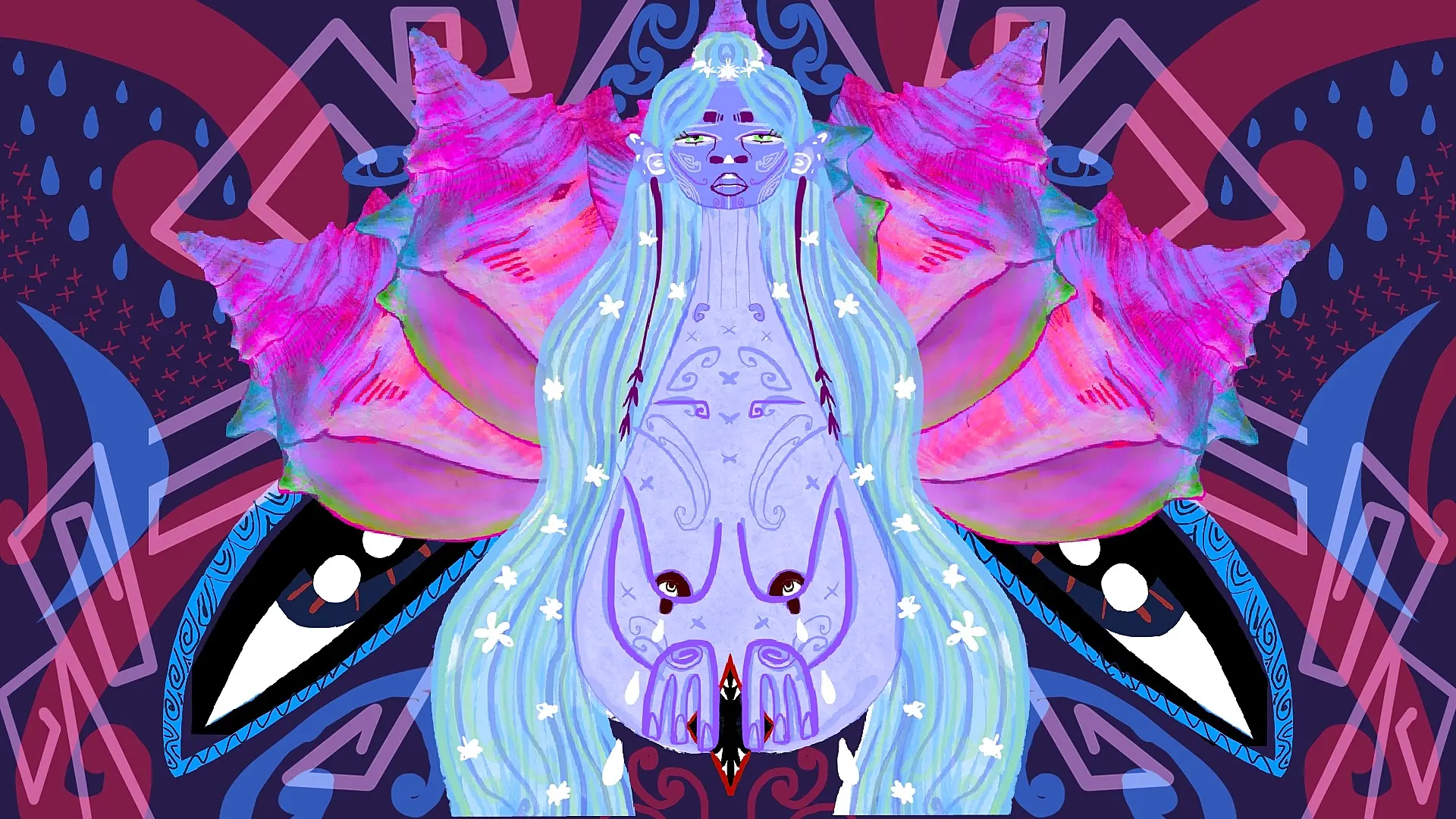
First I need to introduce you to the kaitiaki of this issue. Fittingly, Hine Pū Te Hue came forth in the artwork we commissioned from multidisciplinary artist and taonga pūoro practitioner Te Kahureremoa Taumata. This isn’t the first time Hine Pū Te Hue has joined us, she also featured strongly in the essay ‘Wāhine of Taonga Pūoro’, in this poem by Ruby Solly.
Long long ago
There was a fight between our gods.
All the men screamed,
And cried
Threw all they had,
At each other.
Used their creations,
As weapons for which they were never intentioned.
This could have gone on forever.
Except one woman,
No,
A goddess
Saved the world.
Hine Pū Te Hue
Took in all their pain,
All their anger,
and she grew a world
within herself
a sphere from deep
in the pito,
and she let out,
a song to calm the world.
As the ancestor of the hue, or gourd, and with deep associations to taonga pūoro, Hine Pū Te Hue is who you’d really want as your kaitiaki for a vessel-themed kaupapa. It just makes sense. Taonga pūoro themselves are vessels and they don’t just create sound. They’re an integral part of Māori life and have uses across a diverse range of practices. In our Art section, Curator Mātauranga Māori Isaac Te Awa talks to taonga pūoro makers on their crafting practices. Also in Art, Curator Grace Lai redeems the bag, pointing out that its varying uses go beyond the Western handbag and ostentatious displays of wealth and style, into other cultures and uses. She does this in conversation with designer–maker Vita Cochrane in the context of An Anthology of Bags,her upcoming exhibition at Anna Miles Gallery.
In our Performance section, not only is our behind-the-scenes roundtable interview with the makers of Break Bread– Sophie Roberts, Alice Canton, Freya Finch and Leon Wadham – in written form, but we’ve got a video recording for the more visually inclined. Break Bread is the newest commission from Silo Theatre, a digital production opening on Tuesday 30 November with tickets available now on the Silo website. This is highly recommended reading and viewing, with plenty of laughs (it’s hosted by comedian Alice Snedden!), for anyone interested in theatre-making practice.
It is true that our bodies are repositories for many things, including whakapapa, pūrākau and the stories of our ancestors. Also, sometimes, a lot of coffee and takeaways
In the PP Team piece, ‘Our Favourite Vessels’,Lana posits that “our bodies are incredible vessels that grow our future ancestors, and mine held my most precious measina – my kids.” It is true that our bodies are repositories for many things, including whakapapa, pūrākau and the stories of our ancestors. Also, sometimes, a lot of coffee and takeaways (McDonalds and Mi Goreng noodles yesterday). When your vessel starts to change shape around the middle, becoming more of a hydria than a loutrophoros in Greek vase types, it’s a sign to do some exercise and get the blood pumping.
Blood cells are a particularly important vessel; they carry oxygen from the lungs to the body tissues and carbon dioxide, as a waste product, away from the tissues and back to the lungs. In our Literature section, Lana Lopesi’s collection of essays Bloody Woman follows the clotting in an exploration of being a woman and Sāmoan. We’ve collected responses to the text from Pacific women Leafā Wilson, Tusiata Avia and Pelenakeke Brown.
Litia Tuiburelevu reminds us why those of us who are femme-identifying are all a bit f****** up about our bodies
Vessels of transportation brought us to Aotearoa, whether ancestral waka, ships or planes. But it’s a two-way deal (well maybe not quite at the moment); those who are from here also leave. In our Society section, Vanessa Ellingham explores being someone of Māori descent who is also a migrant – namely to Berlin. She meets with a group of Māori who live there and finds that their “way of being at home consists of talking about it.” We only have to go back as far as Disney’s Moana to know that this migration is not a recent development, Pacific explorers are celebrated as the most legendary ocean voyagers this world has ever seen.
In her third and final installment, ‘Stay Sexy, Always Stay Sexy’(no, plz, no, don’t leave), Litia Tuiburelevu reminds us why those of us who are femme-identifying are all a bit f****** up about our bodies (BIPOC women in particular) in this trawl back to the days of the ‘Sealed Section’ of Girlfriend magazine. Yes, I know you know what I’m talking about.
From the warm embrace of a sweaty sleeping gown
From the warm embrace of a sweaty sleeping gown (stay sexy Ataria, always stay sexy), I extend thanks to all of our contributors to Vessel: Litia Tuiburelevu, Vanessa Ellingham, Ashleigh Taupaki, Isaac Te Awa, Ronia Ibrahim, Grace Lai, Amit Noy, Ghazaleh Golbakhsh, Bronnie Wilde, Devika Ratanpal, Deb Rawson, Madeleine Crutchley, Naomii Seah, Benjamin Mollison, Jordan Hamel, Leafā Wilson, Tusiata Avia, Pelenakeke Brown, Rachel Trow, Han Li, Naomi Simon-Kumar, Ankita Singh and our team at The Pantograph Punch –Lana Lopesi, Sherry Zhang 章雪莉, Ana McAllister, Sinead Overbye, Faith Wilson and our subeditor Marie Shannon.
Now it’s time to have a shower.
1 The state of looking like you just rolled out of bed unshowered and feeling gross.