The Unmissables: Four Exhibitions to see in April
A monthly round-up of notable, controversial and unmissable exhibitions in Tāmaki Makaurau and beyond.
A monthly round-up of notable, controversial and unmissable exhibitions in Tāmaki Makaurau and beyond.
Something that often gets doesn't get much of a look-in when we put together our unmissable exhibitions each month are the many public programmes and events that support them. Talks and workshops are a totally different way of soaking up the arts in Aotearoa, and in any given week there are always plenty to choose from.
Particularly tempting at the moment are those being offered by Auckland Art Gallery Toi o Tāmaki, including a conversation between our very own Director Rosabel Tan and feminist theatre maker Julia Croft as part of the She Claims: Art Matters talk series, and a clay art making workshop with Wi Taepa the day after his much-anticipated retrospective opens. These two will cost you some pennies, but there are also plenty of free events about. Drop by Mōkopopaki between 11am and 3pm tomorrow to catch watercolourist Allie Eagle at her easel, or head out to Mangere Arts Centre - Ngā Tohu o Uenuku on April 21st for the opening of Wantok followed by a panel discussion with exhibition curator Luisa Tora, Dr Tarisi Sorovi-Vunidilo and the artists. Next weekend you'll be particularly hard-pressed for choice with a roundtable on Art and Labour being hosted at Te Tuhi in association with John Vea's exhibition (featured below), as well as FAFSWAG and The Pantograph Punch hosting ATTACK THE BLOCK, an entire days worth of talks and workshops at Q Theatre – this one is free but registration is essential and spaces are filling fast!
To help you navigate the latest art offerings, as always our team have put together four unmissable exhibitions taking place in Pōneke and Tāmaki Makaurau right now.
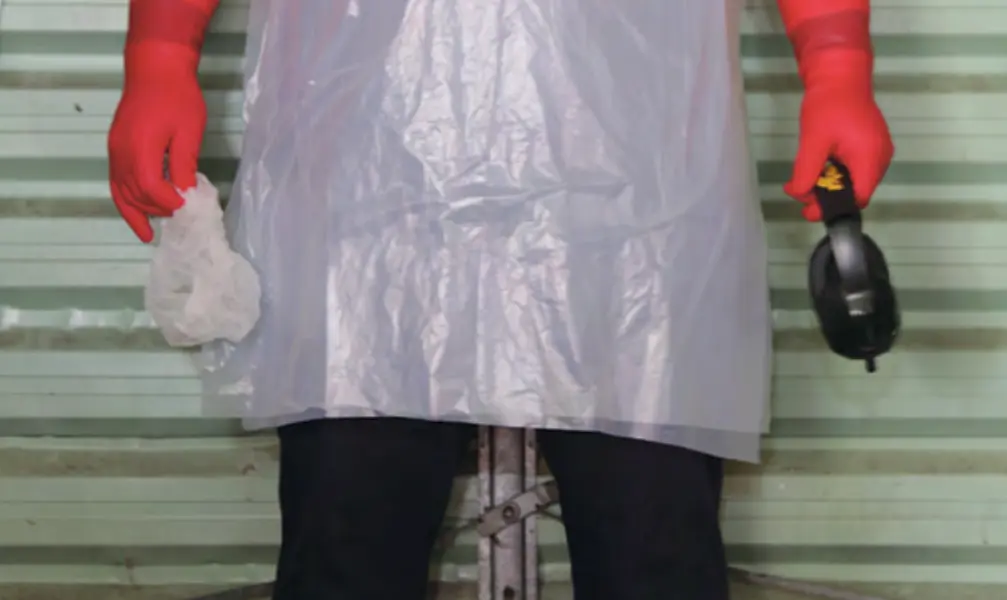
John Vea, “you kids should only experience this for a moment – don’t be here for life like me”, 2018. Installation view at Te Tuhi. Photo by Sam Hartnett.
“you kids should only experience this for a moment – don’t be here for life like me” grows out of the artist’s first-hand experience of working in a potato chip factory. In a darkened room, walled off with heavy flaps of transparent plastic, he presents a poetic evocation of the tedium of such labour. Vea and a second man appear as projections, shuffling restlessly before a recreation of a roller-based conveyor. Uncanny plaster facsimiles of potatoes jostle together, slowly being ground down. Dust accumulates on the floor in piles vaguely evocative of sand at the bottom of an hourglass.
At regular intervals, the monotony is punctured by a television starting up. On the screen plays an Al Jazeera newscast, the typical entertainment during break times. For a short while, the outside world leaks into Vea’s enclosed and gloomy vision of the factory: a space that for some might represent a useful source of additional income, to be tolerated from time to time, but that for others – like the woman quoted in the title of the exhibition – is the site of an endurance performance, repeated day after day, with no end in sight. – Francis McWhannell
John Vea“you kids should only experience this for a moment – don’t be here for life like me”
Te Tuhi
11 March – 22 July
Andrew Blythe, Untitled, 2016, crayon on paper, 420mm x 297mm. Image courtesy Tim Melville Gallery.
No is a quiet resistance to the rising staccato and lengthening hum of a new day. It rises and falls, tracing the arc of the earth as a vessel on turbulent seas. No is the quiet solitude of a handmade blanket, an empty diary, the clarity after a fever. No is a defiant stand against uncertainty, darkness, stasis and saying I’m sorry.
There is a lyrical quality to the rhythmic march of paint across a seamless ground. In Cartography of the Unknown at Tim Melville Gallery, Andrew Blythe’s iconic ‘cross’ paintings, and fluid poured ink works, become malleable under the eye. They take on the regularity of fibre arts such lalava and tukutuku, as well as the geometric enclosures of city blocks and units. They dissolve into protests, or become washed away in thin skeins of paint. While his mark-making threatens to overwhelm, we also sense that this process is a means of emptying out, a negation or jettisoning of thoughts, so that the painter arrives at a cathartic state.
Two crayon drawings are the only figurative elements in this otherwise abstract exhibition. In a similar vein, they present elusive scenes denying a easy reading or attribution of meaning. Collectively, these suites of work hum with a vitality and quite confidence, drawing the viewer into an intimate experience. Blythe’s works don’t announce themselves as others do with a blare of fanfare or fireworks, instead they crackle with the intensity of oncoming thunder, utterly enthralling. – Amy Weng
Andrew BlytheCartography of the Unknown
Tim Melville Gallery
3 – 28 April
Ruth Cleland, Silver, Floor, Grid, 2018, acrylic on aluminium composite panels 821 × 1560mm in three parts. Image courtesy Melanie Roger Gallery.
Ruth Cleland's exhibition Fluorescent features a small selection of photo-realistic paintings meditating on the fluorescent-lit spaces that contain our lives. On the walls of Melanie Roger Gallery are ten works depicting grids and fluorescents, although the lights are often not depicted directly. They are instead shown as reflections on institutional floors that shine dully where the cleaner’s mop has just been.
This show has the feel of driving through suburbia to pick up the kids from school, or visiting an elderly relative in hospital. It's same old, same old until one suddenly finds themself lost in the details. Cleland's works are intense, meticulous inquisitions into the design behind all those liminal spaces we routinely pass through – foyers, hallways, waiting rooms. Cleland’s walls and floors are paired with painstakingly-painted grid paintings of yellow, blue and silver that emphasise the composition of the walls and floors within her other works and also all around the viewer. The viewer soon becomes self-conscious of the layered grids she has cornered herself within. – Eloise Callister-Baker
Ruth ClelandFluorescent
Melanie Roger Gallery
28 March – 21 April
Luke Willis Thompson, autoportrait, 2017, 35mm, silent, b&w. Installation view Adam Art Gallery Te Pātaka Toi.
Diamond Reynolds is singing, and I can’t hear a word. Luke Willis Thompson’s eponymous exhibition brings together three video works, How Long? (2018), Cemetery of Uniforms and Liveries (2016), autoportrait (2017), each placed at one of the far reaches of the blacked-out Adam Art Gallery. They are all, as has often been said of his work, concerned with trauma, memory, and site. They are all silent.
Thompson’s works span countries – Fiji, Britain, the USA – and histories – militarization, police brutality, the politics of representation. Beyond their shared concerns with violence inflicted on non-white bodies and what Thompson calls “embodied timelines”, it seems something must be asked of our relation to these articulated portraits, because blackness is not brownness, is not Indigeneity, and trauma is not a map (Emma Ng has written extensively on this tension here).
I mean that it is difficult, in these blackened chambers, to discern what the exhibition is trying to do by showing these works together. The catalogue essay by Stephen Cleland suggests that the darkness ties the films together into a single conceptual space, “giving the sense that we have entered one work rather than three.” It is a space they have not before shared. But while the darkness might act as bind, it can also be read as void: between the varied histories the works speak to, between the galleries which commissioned these works and the locations in which they were filmed, and between us viewing them here, and the subject living out there.
Tell me, is the exhibition made up of things that are foreign to one another? Or do they share a knowledge? I can’t work it out. – Hanahiva Rose
Luke Willis ThompsonAdam Art Gallery
21 February – 15 April