Review: Fallout: The Sinking of the Rainbow Warrior
Sam Brooks reviews Fallout: The Sinking of the Rainbow Warrior
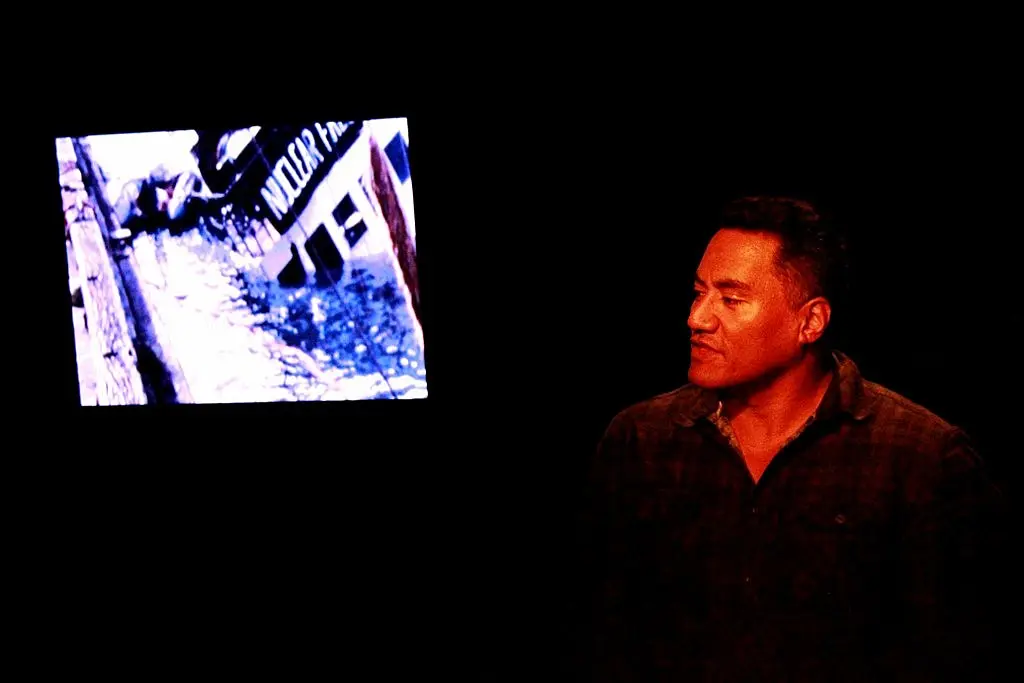
As the title suggests, Fallout: The Sinking of the Rainbow Warrior, is about the bombing of the Greenpeace ship by two French agents in 1985. The Rainbow Warrior has achieved an almost mythic status in New Zealand history. It’s a symbol for those who lived through the time, and for others it’s something they might’ve studied briefly during social studies or history, somewhere along with Kate Sheppard and the Springbok Tour. It's seen as an event that is remembered, rather than an event that someone once lived through and experienced.
What Fallout does is try to turn an act of remembrance into a piece of drama, and it is only intermittently successfully at that. Bronwyn Elsmore’s script uses a verbatim style, think Munted or the simply titled Verbatim, and slides in and out of time very easily. With a large group of characters, from people who met the French agents to New Zealanders living in France to Greenpeace activists at the time, it details the events of the Rainbow Warrior bombing, including the lead-up and aftermath.
Reconstructing an event like the bombing of the Rainbow Warrior in the way that Fallout does is a difficult task. On the one hand, the writer has to be truthful to the facts of the event: Two French agents bombed a Greenpeace ship heading for the Mururoa Atoll. A photographer died. The French agents were caught very quickly afterwards. However, on the other hand, the writer has to graft a dramatic arc onto that event that might not be there naturally.
When you look at the Rainbow Warrior bombing from a top-down view, there’s a lot of conflict, but primarily on a political level. The implications of an ally nation engaging in an act of terrorism on our soil is tremendous, and there’s a lot to discuss in that, especially for what it meant for New Zealand and French relations after the fact. However, it’s very hard to engage with that in a verbatim style, largely because you’ll be talking about the aftermath of the event, and using the voices of people who probably went there. It might make for a more interesting and heady play, but that’s not the focus of this play. The focus of this play is the people who were there.
However, this focus robs the play of one of the essential pillars of drama: Conflict. There’s an inherent lack of tension in this retelling because there’s nobody is on the other side. Nobody in the play is pro-French, pro-bombing, which is entirely understandable. For one thing, I’m not entirely sure those people exist in New Zealand so trying to represent a viewpoint that might not actually exist, or provide any useful commentary on the event the play is retelling is a fool’s errand. However, it means that the play ends up being a very one-sided piece of storytelling, and the inherent drama of the event isn’t enough to keep us engaged. We know where the story is going and we know how it ends.
This lack of conflict would be easy to forgive if there were characters to hold onto, but the script also lacks that. There’s a wide range of characters, and although a few stand out in the memory, like Kerry Warkia’s New Zealander living in France or Fasitua Amosa’s policeman, this is largely due to performance. It’s not only the amount of characters, but the lack of definition in character voice that makes it difficult to hang onto. The characters speak in a similar, vaguely defined voice, and although there are clues in performance and context to determine between them, too often we are left figuring out if we’ve seen a certain character before and then we’re hearing the next character speak.
Photo: Cherie Moore
from May 20 - May 30See also:
Janet McAllister for The NZ Herald