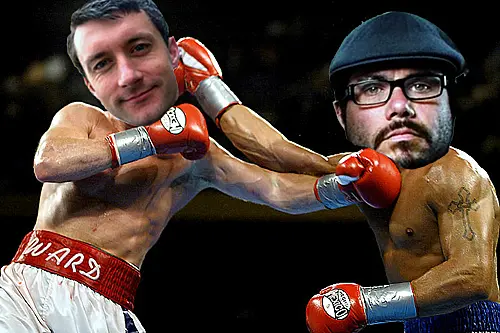

In 2003, Duncan Greive wrote a damning review of Opensouls which resulted in "The Critic", a song that passionately slates him and asks, “What’s with all the criticism?” Nine years on, Chip Matthews and The Critic himself discuss the review, the song, and how they feel about it now.
A few weeks ago, Autozamm came out of hiatus with The Review, a song that aims to makes an example of Simon Sweetman “on behalf of every fucking band in the country.” Asides from the dystopian vision where Autozamm have the power to speak for all of New Zealand music, it’s a pitiable l’esprit de l’escalier: a delayed reaction to a post Sweetman wrote two years ago in which he expressed his disbelief that “a nothing band, an awful collection of not-quite-garage-rock sounds clashing with not-quite-pub-rock and not-quite-indie-chic” had received over $200,000 of NZ on Air funding since 2003.
The song is neither clever nor good, and mostly serves to strengthen Sweetman’s original comments. Furthermore, the impetus behind it, tongue-in-cheek or no, is patently outrageous: the idea that being a critic, and doing your job, is a punishable offense – and will take the form of, well, this:
As I mentioned in Part I, this isn’t the first time critics and artists have crossed swords in this way - and certainly it’s been done with more style. In 2003, Duncan Greive (former editor of Real Groove and current writer at Metro) wrote a damning review of Opensouls’ performance at the 95bFM Summer Series which resulted in "The Critic", a song that passionately slates him and asks, “What’s with all the criticism?”
The defensive hostility that comes with receiving a bad review is understandable, but the question posed in the song is like asking a chef, “Hey what’s with all the cooking?” Answer: It’s their job, and responses like this often stem from the sentiment that a reviewer should support rather than criticise local art, as though the two are mutually exclusive, and this is a dangerous thing.
But whether it was a sentiment held by the band is another question altogether, so a couple of weeks ago we sat down for a beer with Chip Matthews (the bassist for the now-defunct Opensouls) and The Critic himself in what would be their first ever encounter to discuss the review, the song, and how they feel about it nine years on.
ChipIt was a really immature time for [Opensouls] because we were so unsure about where we were going and where our voice was and there was a sense of fragility in those days. And when that review came out, I think Jeremy and Bjorn just didn't know how to react. I mean, how do you - when you’ve come through this period where New Zealand music had suddenly became recognised and appreciated? And there was this lovely bubble around New Zealand music that kind of got popped. But it was the beginning of dialogues that are supposed to be healthy about our music - and isn't it a sign of maturity in your scene when you can take the negative with the good and turn it around and use it?(pause)I think "The Critic" is still a great song.DuncanI think it was the best song of the Opensouls’ early career by far. It felt like it was about a specific thing, and there was a lot of venom and feeling in it that I wasn’t detecting elsewhere. I remember we had a show on bFM at the time and it would get playlisted and it was this bizarre situation where I was playing a song that was partially about me and I would be talking positively about that song as the band’s best work. It was really quite a strange era but I think through that kind of awakening and the kind of arousing of tempers, good things came out of it.ChipTotally, and pre- that era, criticism was rare. I remember trying to track down Grant Smithies after I got a bad review for something. I don’t know what it was but I tried tracking him down. I started emailing people. I think I rang whoever he was working for. And I wanted to know where he lived. He was negative about Loungehead probably – because Grant Smithies was never a Loungehead fan. Kind of thought we were overrated ad-makers. As a band. Which in some ways he was right. But I was going to go and fuckin’ – but then I found out he lived in Nelson.DuncanThat’s a long way to go to beat someone up.ChipI was down there on Che Fu’s tour and he tried to get backstage. Our manager at the time gave him a big fuck off and I only found out later. I was so close to getting my goal - but then a few years later I realised how stupid I was. Because it just – you know. (pause) But I remember the Summer Series review was extra painful because we came offstage thinking we’d played so well.DuncanThat would have been upsetting for you guys.ChipTotally. And Bjorn talked about it in the song, you know, the fact the crowd were enjoying it. And for a band still trying to decide what we were going to do – I think that was pre- our first 12 inch release as well, it was –Duncan– It was really early in your career for you guys –Chip– Yeah and it was really formative days – Isaac had just joined, we had a revolving line-up, and we thought we fuckin’ –Duncan– killed it.ChipIt was one of those gigs you think, “Fuck, this is it. This is a step up. Next one’s going to be awesome.” And then suddenly: BOOM. Fuckin’ boom. Kneecapped by a dude we didn’t know, and it was just like: Fuckin’ cunt. Fuckin’ asshole.(Duncan laughs, a little nervously)And then "The Critic" came about. And those were the days when Simon Sweetman was still writing glowing reviews about everything and then it was almost like he went into a hole and realised he could do this other stuff – I love Simon. He adds a lot to the music conversation. It’s a typical kind of dialectic where you have to have the thesis to have the antithesis to have the synthesis and he’s that guy – the Whale Oil of music blogging.Duncan(laughs) I would agree with thatChipHe goes exactly one way, he says it completely, and he puts it out there. But I don't mind it.DuncanI think it’s good that that presence exists. I can’t really stand him because I feel like he’s being reactionary for reactionary’s sake. It doesn’t feel like a deeply-held opinion. I remember that famous thing he wrote about New Zealand hip hop basically sucking and from the way it was written you could tell that to make such a deep and sweeping statement there was nowhere near the listening that had gone on to be able to do that, and to a certain extent I defend a critic’s right to do that, but if you’re going to do that without research, (a) you better fuckin’ hope like hell you happen to be right and he wasn’t, and (b) just do it in a fun and stylish way and because he just bangs shit out – he just churns and churns and churns – I don’t find his writing particularly artful.Occasionally I’ll agree with him - like the Fat Freddy’s Drop thing he wrote. I enjoy some elements of what they do and I fuckin’ love that they exist because they set such a powerful example in the way they went about things, but the stuff that was being said about them got ridiculous and I think it was good that somebody went out there and popped their balloon, but generally if you’re going to play the role of provocateur I think part of what’s important is to do it in an artful way. Do it in a fun way. It feels like he’s pushing the same buttons over and over.ChipHe is, but he’s playing to the Stuff crowd – this marketplace that he has – and in that regards he’s doing a fantastic job. And you know with the Freddy’s thing: I’m an unashamed fan of Freddy’s. I love them, and that’s because I know them. I’ve seen them develop. I’ve worked with them. I’ve recorded with them. And I’m also a huge fan of their music. But I really appreciated the fact that someone wrote that in a period where they could do no wrong.DuncanIt’s not healthy for them or for music generallyChipIt’s really not healthy. And maybe it’s a sign of our progression that Simon can start from this extreme point, so that people can filter away the shit and bring it into a serious dialogue.DuncanYou do need someone at an endpoint – you’ve got Fat Freddy’s here and Simon here and the truth is probably somewhere in between.ChipYou gotta have those kinds of polarising factors to try and at least start engaging the population. Because you realise when you read these things that we become so enmeshed in our work that we forget that the majority of New Zealanders don’t really give a fuck. They don’t care about the dialogue we’re having. They listen to New Zealand music in the sense they’ll hear Dave playing on The Breeze and that’s as much as they’ll engage with New Zealand music – and I don’t mind that because I fuckin’ love Dave. He’s the soundtrack to my life. But it’s a process of maturation. A lot of cats don’t give a shit still. They’re not engaged.I think we, in the industry, suffer from having our heads up our asses sometimes. We go to all these industry events and we look at the half-sold-out Vector top section while we’re having our piss-up at the fuckin’ music awards and we think we’ve somehow made it because people want to come and watch us in the gladiatorial den as we get absolutely pissed and embarrass ourselves. But it doesn’t mean we’ve reached any kind of zenith with regards to our musical history. If anything the dialogue is only just beginning so the role of the critic is vital for me at the moment. It’s vital.It was one of those gigs you think, “Fuck, this is it. This is a step up. Next one’s going to be awesome.” And then suddenly: BOOM. Fuckin’ boom. Kneecapped by a dude we didn’t know
This was probably the fifth thing I ever had published and I did not know a goddamn thing about the world except that I wanted desperately to have a little place in it.