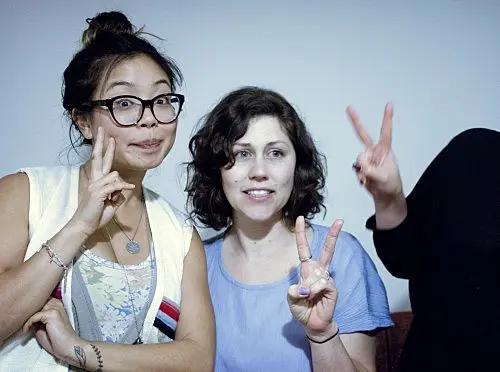
Chop/Stick: Michelle Ang and Jo Holsted in Conversation
Rosabel Tan talks to Michelle Ang and Jo Holsted about their new play Chop/Stick, the thorny issue of ethnicity and the lunches they ate as children.
Chop/Stick is a play of firsts: It’s the first full-length play Jo Holsted has written and it’s Michelle Ang’s first solo show – though she’s by no means a newcomer, having graced our screens on shows like Outrageous Fortune and more recently MTV’s Underemployed.
They're calling it an experiment. An exploration of ethnicity. “We took one Asian actress and turned her into a ballsy British casting agent,” reads the invitation to their script development session. “And a bumbling white guy. And his New Zealand Asian love interest. And you know, some others. If you can see where we’re going with this.”
You can, and you can’t, because regardless of how an ‘Asian play’ is packaged it’s still tagged with a set of preconceived notions about what it means to represent that experience onstage. You don’t expect it to be incredibly funny, for instance, but Chop/Stick is absolutely a comedy – as I discovered one afternoon in the boardroom at Planet FM, a community-access radio station located on a grassy knoll at the outskirts of the Unitec campus.
Both of them break into nervous smiles when I walk through the door. “Thank you so much for coming to our reading,” Michelle calls from the front. She’s clutching the script in her hand and bouncing on her feet.
“Do you want something to drink?” Jo asks. “We have tea, coffee– “
“Don’t forget the expired blood orange vodka,” Michelle adds.
“Oh yeah,” Jo smirks, because full disclaimer: we live together, and she knows which I’m going to pick (for the record: it was definitely still okay).
Two glasses and a play reading later, the three of us sat down to discuss the origins of Chop/Stick, the thorny issue of ethnicity and the lunches we ate as children.
JoSo in 2008, I was living in Barcelona and Michelle came and stayed with me for three months over the summer. I'd been working at a school –Michelle– and I had saved up some money and was taking intermittent jobs as a film set AD even though I couldn't speak any Spanish –Jo– and we were at a similar point in our lives, career-wise. I had been doing a bit of writing, and Michelle –MichelleI had come off the back of a couple of seasons of Outrageous [Fortune], which was fun, but I'd gotten nervous that there wasn't much left for me to audition for in New Zealand. Looking back that was probably my own paranoia, but at the time it felt very real, and I felt limited a lot by my ethnicity and how the industry was looking at me as an ethnic actress, so I brought that to Jo, and we thought it'd be an interesting thing to write a play about, and it grew from there.JoA one-woman play was sort of perfect, with Michelle playing all these characters that represented many of the things she wouldn’t be cast for, or wasn't being told she could be cast for –MichelleYeah, it was a way of creating roles that seemed totally absurd that I'd ever have a chance to play.[pause]But we're also two representations of people who could be considered in-between, which is what we're trying to explore with Chop/Stick. The fact that it's kind of hard to have definite boundaries, because while I have the personal experience of having a Chinese upbringing, I was born in New Zealand. I also went to school in New Zealand. I have a lot of Pakeha friends – like, there are things I think are hilarious about Chinese culture when I look at them from a Western viewpoint, and likewise Jo went to a school where there were lots of mixed cultures and she's not, you know, a redneck white person –JoThank you!Michelle[laughs] Well you know, you've experienced just as many cultures as I have, really –JoYeah, in terms of the in-betweeness we're so fascinated with, more than anything we wanted to have this conversation – this idea of face value –Michelle– and the quickness of people to assume there's a delineation between themselves and others - when really there's so many crossovers –JoYeah, the 'us' and 'them' thing is something we keep coming back to when we're talking about this. I don't even know who 'us' or 'them' is supposed to be anymore. But there still seems to be a sense of people being themselves and 'other', as though 'other' is a potential group.MichelleIt's recognising that everyone is an 'other'. We're celebrating that nobody is that different – like, everyone is different, but nobody is that different that they're no longer unrelatable and totally distinct from you, you know?JoWe've joked about this seeming like we're doing a disservice to people who are celebrating their culture, or their difference, but at no point have we ever wanted to say that you shouldn't celebrate your differences, or be proud of your cultural heritage. It's great to be proud of that. It's when you see yourself as being different from other people in a way that separates you from them: that creates a lot of misunderstanding. And it's especially interesting in a New Zealand context because – [shudders] – I hate the term melting pot, but you know, it's a prime example of a melting pot. It's unbelievable to me that there can be a sense of ownership of New Zealand. Even being a majority in New Zealand seems ridiculous to me, because you're one of so many different options of what can be considered a New Zealander.MichelleYeah. I mean, immigration has made this country.RosabelDo you feel like you identify quite closely with your ethnicity?MichelleNo. I forget. I feel like a New Zealander, and I forget that I'm one or the other. I've actually said things like, "Yeah, cos us white girls don't have any culture," and my friends have been like, "Missy, you're not white." [laughs] I was like, "Oh, shit, yeah." So because I recognise myself as a New Zealander and I guess the majority of New Zealand culture is white, you could say I don't relate to my ethnicity. But when I look really critically at how I live my life, and my values, and even the food I eat, I have managed to pocket these parts of my life which are still quite Chinese. But I guess I don't recognise them because that's how I've always lived.[pause]But you know, I wouldn't necessarily invite some of my Pakeha friends to my Aunty's place for pig's stomach soup, which I had last night [laughs].Jo[in an Australian accent] Sicko.[laughter]RosabelI find it interesting because I’ve had these similar experiences with how I relate to my ethnicity. I don’t feel like it forms a core part of my identity, but there have been situations where it’s been brought to the forefront, like – when I first moved here. I was eight, and it was during that first big wave of immigration and I became friends with this girl from Hong Kong. And I remember her grandmother would show up every lunchtime with these little containers of food – rice and meat and things, and my mum would always make me ham sandwiches, because I guess she was quite aware that I was growing up in a different culture. But I just remember this one time when I was sitting with this girl and her grandmother, and her grandmother saw my ham sandwich and laughed at me. And she said something in Cantonese, and I asked my friend what she’d said, but she wouldn't tell me, and – it was really upsetting. I stopped eating lunch for about a month after that. I'd throw my sandwiches away, and eventually I stopped spending lunchtimes with that girl, but in retrospect it was around that point that I started quite aggressively rejecting my culture – because of the way that experience made me feel, because I felt like I was being ridiculed for not being a real Chinese.MichelleYeah that's really interesting because mine is the opposite. I always felt weird being Chinese, but the irony is that my Chinese-ness isn’t very Chinese. My mum's attempts to make me be Chinese was from a very weird misguided place, because she wasn't educated in a Chinese school when she was growing up – she's actually fairly Western. And so it's made for a mixed bag for me too.[pause]I wish I got ham sandwiches.RosabelThey're not that great.MichelleNo, they were the best! I would have died if I’d had ham sandwiches.RosabelWhat did you have for lunch?MichelleMy mum would put things like kaya in my sandwiches, which is this coconut custard–RosabelI LOVE THAT STUFFMichelleYeah but it looks weird, and it smells weird, and it's very different. And it was not cool to have. No one wanted to trade sandwiches with me.RosabelI would never have been allowed that for lunch. My mum would’ve said it'd make me fat.MichelleMy mum pretty much MADE me fat. She gave me juice every day.JoI feel like I need to tell a lunch story.RosabelTell a lunch story!JoWell, I mostly used to make my own lunch, but when I was six or seven, my dad would sometimes make my lunch, and he would get a cookie-cutter, like a rabbit shape and cut it into my sandwich so it was a rabbit-shaped sandwich, and at first I thought that was so cool, and then one day I just got embarrassed by that, and I did the same secret throwing out of sandwiches. Which actually now is making me want to cry thinking of my dad doing that cute thing and me wanting to throw it out, but... I just wanted you guys to know that it happens to non-Asians as well.[laughter]