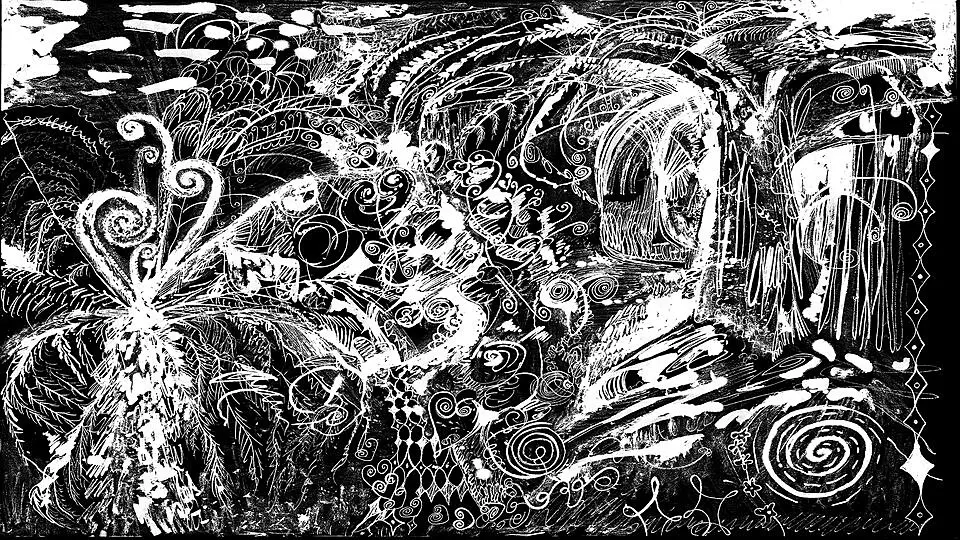
Bush
A year ago, Ataria Sharman, Editor of The Pantograph Punch, dreamed of the art and culture journal being sexier. In her final issue, she reflects on this and welcomes new growth.
I’ll let you in on a secret. A year ago, literally to the month, the new Pantograph Punch team met for the first time in person at our strategy hui. We'd had a shift in team members, including a new (at the time) Interim Director, Lana Lopesi, and myself stepping into the editor role with trepidation after Co-Editor Faith Wilson left to pursue her projects (enter Saufo‘i Press). Sherry Zhang had also joined the team as our new Communications Manager, with staff writers Ana McAllister and Sinead Overbye.
A pot of plunger coffee, healthy snacks, lollies and bananas fuelled our tinana. We sat around a large minimalistic white table at Grey Lynn co-working space CHAIRS™. We talked about where we thought Pantograph was now and where we wanted it to be. I stood and shared intellectual thoughts on how we could be a more refined arts destination for the discerning reader – just kidding. As a team, we spoke about the perception of Pantograph as inaccessible, exclusive, white and pretentious. Whether this was true wasn’t relevant; it was how people viewed the site.
I stood and shared intellectual thoughts on how we could be a more refined arts destination for the discerning reader – just kidding
The new team talked about how we wanted to change this and reach communities that might not typically access long-form arts and culture writing. As the editor, I told them I wanted Pantograph to be sexier. Like a nerdy, brainy, artsy, confident sexy.
A year really can shoot past just like that, and changes in my own life reflect changes in the work, too. I wasn’t even on TikTok in May 2021, and now I’m listening to music by influencers and simping over content creators ten years younger than me. At Pantograph we’ve seen innovations since then, too. Since May last year, we’ve released four issues under a new bi-monthly model: Te Kore, Inhale | Exhale, Vessel, Heat Wave and now the best of the thicket (¬‿¬) – Bush.
Could I have done better? That’s the most challenging question for an editor of any publication
This is my final issue as the Editor of The Pantograph Punch. I first came across Pantograph during university when the skux piece by Tayi Tibble went viral on my feed – she’s the iconic writer who is the Guest Editor for our next issue, Vibe Shift. It makes sense that, with the circular rhythms of nature, as I move on, Tayi’s returning. I’m leaving to work on my own projects. You can follow me on Instagram: atariasharman and awawahine.
Could I have done better? That’s the most challenging question for an editor of any publication. Of course, yes, I could’ve done better, responded to more issues, included more perspectives, and provided more coverage for more artists. I mean, you can never do enough, you know? But I’ve always tried to do my best, particularly in providing a space for writing by contributors from diverse communities.
We’ve had our share of sexy writing, including Litia Tuiburelevu’s standout series on dating in Tāmaki as a Brown woman and everything Ana McAllister ever types
We’ve had our share of sexy writing, including the fantasies of Sinead Overbye and her real-estate-agent alter ego, and feeling horny with Nathan Joe in Thirty, Flirty and Tired. Our most recent team piece on thirst-trap photography is out of the Pantograph box, for sure. Then there’s Litia Tuiburelevu’s standout series on dating in Tāmaki as a Brown woman and everything Ana McAllister ever types.
Bush, a seed planted in a Zoom hui by Faith Wilson, was weeded, watered and fed by the team
At the same time, we’ve interrogated the supremacy of whiteness in Aotearoa. Naomii Seah interviewed Chye-Ling Huang and James Roque on why they’ve only dated Pākehā. Ronia Ibrahim's republished comic highlighted the challenges of being biracial. Litia again asked why so many Brown boys have a penchant for white girls. Pacific couple Taualofa Totua and Iosua Ah-Hao shared their love experiences through literature. Makanaka Tuwe interviewed African musicians in Aotearoa, and Shaneel Lal celebrated Indigenous Queerness.
***I’m excited to present Bush to you. A seed planted in a Zoom hui by Faith Wilson, weeded, watered and fed by the team, and left to grow shoots into the plant it has become with each submission, pitch and first draft received. Many of the pieces in this issue go into the dark, dank soil of the underbrush, exploring narratives of Indigenous peoples, practices and whakapapa. The Atua Māori also joined us in pieces that unexpectedly brought them to life: a reflection on children’s books and missing pre-colonial narratives by Claire Mabey, Rachel Trow’s hilarious ranking of the waiata of native manu, a revisit to the legacy of illustrator Brian Gunson by Arihia Latham, Gabi Lardies' coverage of the McCahon kauri tree regeneration project.
To our readers and writers, Pantograph doesn’t exist without you
Nau mai haere mai to our contributors to this Bushy offering: Divyaa Kumar, Arihia Latham, Faith Wilson, Claire Mabey, Chris Tse, Kate Prior, Makanaka Tuwe, Ana McAllister, Gabi Lardies, Briar Pomana, Rachel Barker, Nam Woon Kim, Kitty Wasasala, Rachel Trow, Vanessa Mei Crofskey, Mya Morrison-Middleton, illustrator Abigail Aroha Jensen, and our subeditor Marie Shannon.
I’d like to thank everyone I’ve worked with over the last three years: Kate Prior, Hannah Newport-Watson, Faith Wilson, Lana Lopesi, Vanessa Mei Crofskey, Sherry Zhang 章雪莉, Ana McAllister, Sinead Overbye, Nuanzhi Zheng 郑暖之, Mya Morrison-Middleton, Delilah Pārore Southon, Anastasia Burn and Marie Shannon. A big thank you to the Board, particularly Rosabel Tan, Hayden Eastmond-Mein and Jessica Smith, who’ve been there the whole time, right from the start. To all the artists, illustrators and creatives I’ve had the privilege of working with, thank you for sharing your mahi with me. And to our readers and writers, Pantograph doesn’t exist without you.